The uses of artificial intelligence continue to expand in both scope and sophistication.
According to Accenture, AI will remain the centerpiece of 2026 investment strategies, with almost 9 in 10 organizations planning to increase their spending.
In this article, we’ll explore the fields in which AI is used and take a look at its core use cases and practical applications across different business operations.
AI in 2026 and Beyond: Key Stats and Facts to Know
It comes as no surprise that artificial intelligence is fast becoming the defining technology of our time. A report by the United Nations Conference on Trade and Development points out that the global AI market will soar to a whopping $4.8 trillion by 2033. Moreover, according to McKinsey’s survey, 88% of 1,993 respondents across 105 countries reported using AI on a regular basis in at least one business function.
Generative AI deserves a separate mention. Deloitte’s 2026 State of AI in the Enterprise report emphasizes that businesses place enormous expectations on GenAI. The areas that leaders believe will have the most profound impact include search and knowledge management, virtual assistants and chatbots, and content generation.
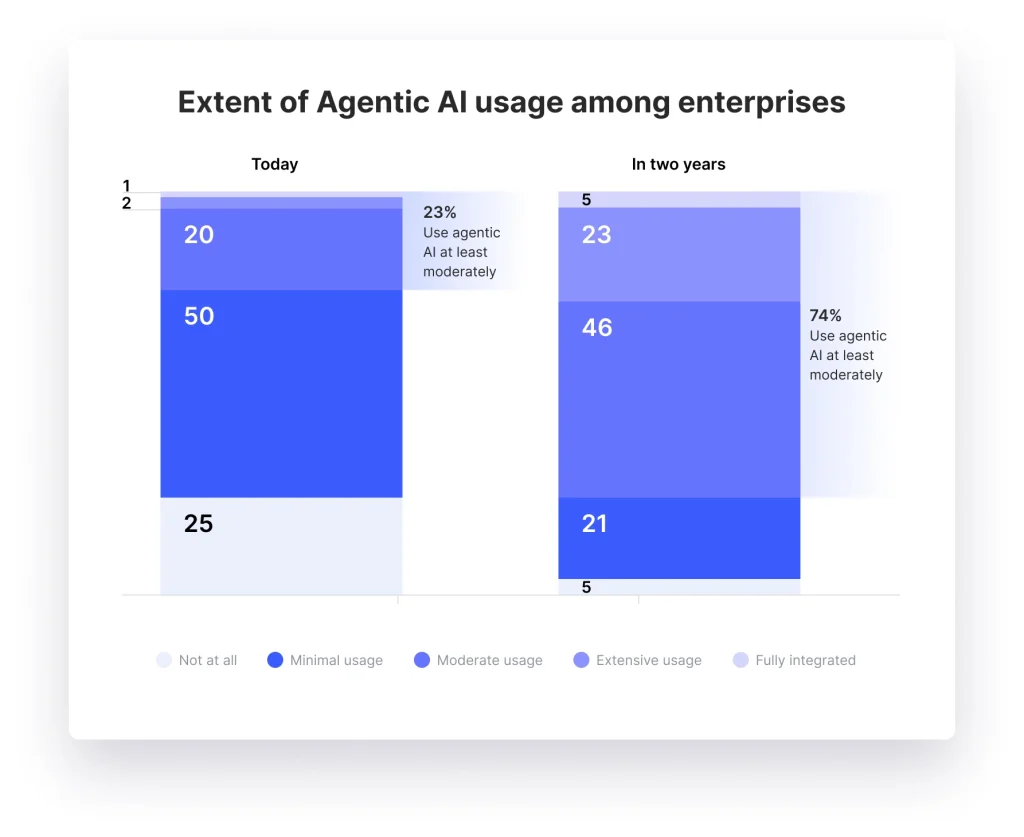
The same report also covers the growing importance of other AI paradigms, namely agentic and physical AI.
It states that agentic AI will have the highest impact in customer support, where autonomous systems can resolve complex queries end-to-end. On top of this, its high-potential use cases are also emerging in supply chain management, R&D, knowledge management, and cybersecurity, where intelligent systems can continuously monitor, analyze, and act without constant supervision.
As far as physical AI is concerned, its use cases span a wide range of industrial and commercial settings. The most prominent ones include collaborative robots that work alongside humans on assembly lines, inspection drones with automated response capabilities, robotic picking arms in warehouses, and autonomous forklifts in logistics hubs.
Main Considerations for Scaling AI
The successful and effective implementation of AI in different fields in 2026 and beyond depends on several factors, yet two stand out in particular, and these are data readiness and trust.
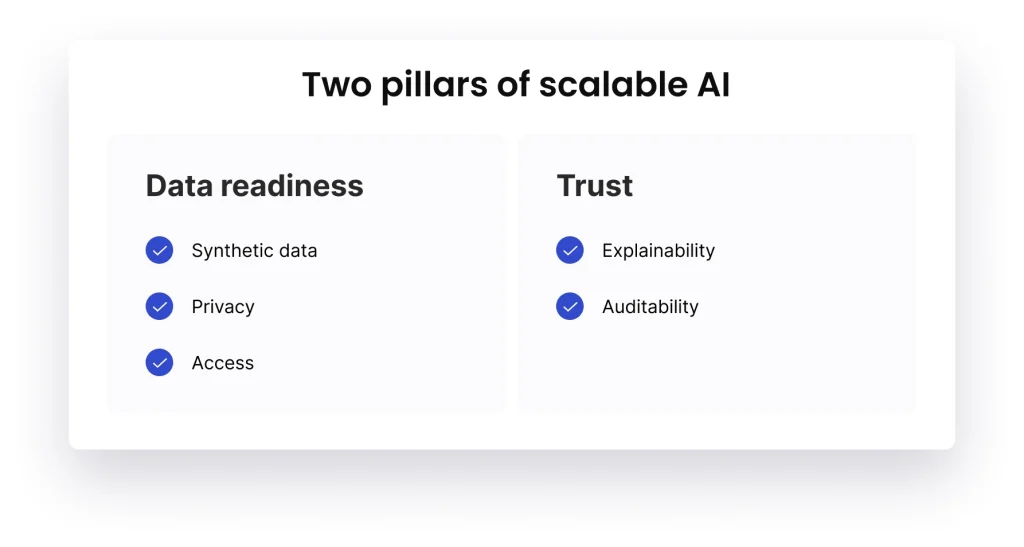
When companies try to scale their AI initiatives, they might stumble upon challenges related to limited, sensitive, and highly regulated datasets. This is where synthetic data becomes especially valuable. Artificially generated yet statistically realistic, it makes it possible for teams to train and test models without exposing personal and confidential information. For many companies, it presents a practical solution to reducing privacy risks, addressing bias, and speeding up model development cycles without compromising compliance.
At the same time, explainable AI, or XAI for short, is also gaining traction. Given that AI models continue to influence a range of spheres, including but not limited to credit decisions, insurance pricing, medical diagnoses, and even hiring outcomes, businesses can’t rely on opaque black box systems.
In this case, explainability techniques such as feature attribution methods, transparency layers, and structured evaluation frameworks help businesses get a grasp of how models arrive at their decisions. More importantly, they also ensure that automated outcomes remain interpretable and auditable and that they comply with regulatory expectations.
What Is Artificial Intelligence Used For: Key AI/ML Use Cases Across Industries
So, now that we’ve covered the key AI paradigms, let’s get down to exploring where artificial intelligence is used and how it creates measurable business value in each sector.

1. AI in Banking and Financial Services
The banking sector has been quick to embrace AI, and for good reason. As PwC states, fully adopting AI could drive up to a 15-percentage-point improvement in a bank’s efficiency ratio, while some leading banks have publicly announced efficiencies from AI in the billions of dollars.
On the front end, many customers interact daily with AI-powered virtual assistants. Behind the scenes, 59% of banking employees already use AI daily via tools like Microsoft Copilot and Salesforce Einstein. These are only a few examples, while the list of AI/ML use cases in finance is long.
Hyper-Personalization
Banks have used AI for personalization for years already, but the bar is rising. Traditional chatbots and recommendation engines are now being enhanced and, in some cases, even replaced by generative AI systems that can understand context far better. These tools are perfectly capable of customizing product recommendations, financial advice, and communication styles to each client’s behavior, risk appetite, and long-term goals. Plus, in asset and wealth management, GenAI supports real-time portfolio insights and scenario modeling that match individual preferences and objectives.
Real-Time Fraud Detection and Risk Management
AI solutions assist financial institutions in monitoring transaction patterns, customer behavior, and network activity and detecting fraudulent activity on time. Furthermore, given that ML models can continuously learn from new fraud tactics and updated data, they manage to improve their detection accuracy and minimize false alarms over time.
Regulatory Sandbox and Compliance Innovation
These days, banks have been experimenting with AI in controlled regulatory environments to enhance their compliance posture. Within these initiatives, they pilot AI agents that are able to reconcile trades in real time, validate regulatory submissions, and identify potential risk breaches. Moreover, banks have also resorted to generative AI to reduce the documentation burden, as the GenAI technology is capable of drafting model risk reports, audit summaries, and compliance narratives much faster than humans.
AI-Driven Loan Management and Credit Decisioning
AI also plays a growing role in loan management and credit decisioning. The best loan management software leverages AI and ML tools to minimize the manual workload of back-office teams and speed up internal processes. JPMorgan Chase, for instance, developed the COIN platform, which uses AI to review commercial loan agreements and legal documents.
AI tools can be very efficient in credit risk management. Recognizing this, banks have been implementing AI-powered solutions, like GiniMachine, to promptly analyze a broad set of financial and behavioral signals and assess probability of default, more dynamically and effectively.
Debt Collection
In debt collection, AI has been used quite extensively. Banks and fintech companies rely on AI-driven digital collections platforms, like HES Collection Agent, to predict payment behavior based on historical and behavioral data, better segment customers, and adapt communication strategies for each borrower in real time.
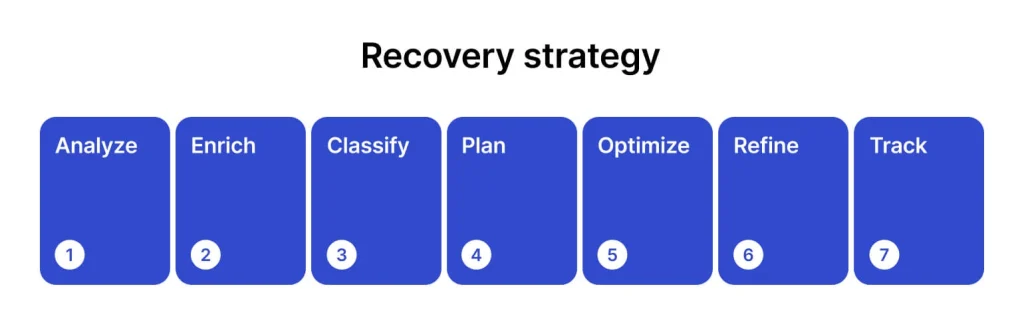
See How a Collection Agency Optimized Its Strategies With AI

2. AI in Healthcare
When analyzing the role of artificial intelligence in different sectors, the healthcare sector is among the first ones to mention. AI decision-making in healthcare has five most widespread use cases:
Disease Prediction With the Help of Statistical Data
AI allows diagnosis and treatment of health issues at earlier stages due to the patient’s medical history analysis. The implementation of this type of AI in the healthcare industry allows for timely prevention, decreases therapy costs, and ensures timely delivery of individual recovery plans.
Risk Assessment
AI-based decision-making systems implement the capabilities of neural networks and machine learning to assist medical personnel in the evaluation of risks and success in treatment.
Managing Pandemics and Minimizing Their Impact
AI and ML in pandemic management can predict the behavior of viruses or pathogens. On a more global scale, technologies analyze and predict how a pandemic spreads and moves to identify the area of lockdowns and protect more people.
Digital Healthcare Tools
AI in healthcare apps helps with diagnosis chatbots and data monitoring to alert potentially dangerous health conditions. Also, it includes Natural Language Programming that translates written or spoken notes into actionable patient data.
Insurance and Financial Management in Healthcare
AI helps to reduce the waste of funds in healthcare and increase the efficiency of services. Analysis of staffing, performance of healthcare facilities, and medication waste helps avoid fraud and provide more tailored policies. AI-based risk management in insurance with the help of GiniMachine helps to assess realistic scenarios and minimize financial losses.
Auto-Generation of Medical Reports and Documentation
GenAI allows for the automated creation and structuring of medical reports based on patient consultations and available clinical data. Here is how it makes this possible: during an appointment, AI systems transcribe speech, extract key medical details, and convert them into structured documentation that populates electronic health records. Then, clinicians tune in to review the generated report and validate that it’s accurate and complete.
3. E-commerce
AI/ML use cases in eCommerce are inspiring and able to change online shopping as we know it.
So, let’s explore the most outstanding application of AI in different fields of eCommerce.
Demand Forecasting
Using AI enables eCommerce businesses to better forecast demand trends and adjust staffing, inventory, and logistics. Plus, retailers employ ML models for analyzing sales data and market signals so as to inform pricing strategies and promotional decisions as well as improve margin control and operational visibility across the entire business.
The Rise of Agentic Commerce
McKinsey reports that even under moderate scenarios, AI agents could mediate trillions of dollars in global consumer commerce by 2030, which surely sounds impressive. Underpinned by large language models, agentic commerce brings about a transition to intelligent systems that can act on behalf of consumers who are searching for products, comparing options, negotiating deals, and executing transactions with minimal human input. Thanks to this, purchasing is expected to get faster, more automated, and increasingly personalized.
Inventory Transparency and Order Accuracy
Once businesses start using AI-powered order management systems, they’re able to better track their inventory levels, monitor shipments, and detect potential disruptions in time. Furthermore, AI-enabled automation reduces manual coordination between warehouse, logistics, and customer service teams, which translates into fewer errors, faster deliveries, and stronger customer trust.
Hyper-Personalization and Greater Customer Engagement
GenAI has contributed to the development of voice commerce and AI-powered social commerce intelligent systems that assist customers throughout their entire shopping journey. Plus, the technology is capable of supporting multilingual communication and culturally adapted recommendations, which empowers brands to provide contextually relevant experiences across different markets.
Intelligent Content Management
Generative AI can free eCom businesses from manually updating descriptions, images, or metadata across multiple platforms. Instead, it automates content creation, classification, and optimization and helps generate product descriptions, marketing copy, visuals, and even interactive content, all while customizing it to different customer segments.
4. Sales and Marketing
We see practical examples of AI in marketing and sales everywhere today, often without even noticing them.
A simple example is smart upsell recommendations: if a customer is browsing a bottle of Sauvignon Blanc, predictive systems might suggest premium oysters instead of unrelated products. Beyond basic recommendations, there are many other use cases that demonstrate where AI is used in sales and marketing, which we are going to explore in more detail below.
Customer segmentation via cluster modeling helps to get insights into customer behavior, demographics, and interests and back up the importance of these parameters. The technique is used in retail, streaming, sports science, email marketing, and health insurance.
For sales and marketing industries using AI, one more implementation option is churn prediction. It helps forecast customers likely to be lost and timely take measures on their retention, calculate the value of potential lost income, and identify customers ready to upgrade their payment plan.
Identification modeling helps target prospective customers, while AI/ML algorithms for lead scoring rank prospects according to their likelihood to convert. The benefits of predictive scoring include having a single trackable metric to analyze customer value, being able to create marketing campaigns with higher ROI, improving conversion and purchase rates, and obtaining reliable forecasts.
Predictive analytics in marketing can be used for content recommendations that engage customers and shorten the sales cycle and for building personalized experiences due to creative surveys and incentives to help your target audience feel highly valued, not haunted.
If you need software for predictive analytics lead scoring, GiniMachine provides a number of advantages: it is a 100% no-code AI platform. All you need to start scoring is historical data in a .xls/.csv file format, with user attributes and records. Each record needs to have a binary status: yes/no, good/bad, repaid/overdue, etc. You can build predictive models for scoring leads in a few minutes and get a detailed report with insights and diagrams.
5. AI for Lending Solutions Beyond Fintech
Artificial intelligence supports the expansion of lending services far beyond traditional financial institutions. As more companies in telecom, e-commerce, and consumer platforms are offering embedded credit services, AI models help these non-bank businesses provide fast, data-driven lending products to customers directly within their digital ecosystems.
For example, Klarna uses AI-driven risk models to power its buy-now-pay-later service for online shoppers, while PayPal applies machine learning to evaluate merchants for working capital loans.
One of GiniMachine’s customers, MobiCom, is a telecom company that created an internal system to grant loans to their customers. The company implemented GiniMachine to approve loans instantly and allow their customers to receive financing in no time.
The loan decision is based on a large amount of data, traditional user information (demographics, income, etc.) and alternative data available to the telecommunications provider. GiniMachine provides a combination of ML techniques to help automate decision-making and validate scoring models in 2-10 minutes depending on the dataset size.

6. AI in Agriculture
Even though the adoption of AI in agriculture comes with certain challenges, such as integration complexity and limited digital readiness, there are lots of promising AI/ML use cases worth exploring. Smart agriculture market is set to grow in the coming years, and its value is expected to reach around $72.1 billion by 2035.
Precision Farming and Crop Monitoring
These days, farmers don’t have to walk around the fields to understand what’s happening with the crops. With data coming in from satellites, drones, soil sensors, and field cameras, AI, instead, helps establish a more vivid picture of plant health in real time. It can also flag early signs of disease, water stress, and nutrient imbalance before they’re visible to farmers.
Forecasting and Operational Planning
Analyzing historical farm data, weather patterns, market signals, and a heap of other external factors, AI solutions help farmers forecast yields and demand fluctuations and make better-informed decisions regarding harvesting schedules and storage capacity.
For instance, GiniMachine algorithms are implemented in WizeRise: the solution combines predictive analytics and precision agriculture to convert field data into actionable reporting. WizeRise helps to find valuable patterns in the loan application to keep risk officers better informed without leaving their offices.
Automation and Smart Machinery
We’re also seeing more intelligence built directly into farm equipment. Autonomous tractors, robotic harvesters, and sensor-driven irrigation systems can adjust their work based on current field conditions, which contributes to greater precision and consistency, especially during repetitive or labor-intensive tasks. And we should also note that as these machines gather more data season after season, they gradually become better calibrated to the specific realities of each farm.
Supply Chain Optimization and Traceability
Farmers resort to AI to analyze inventory levels, market demand, and logistics data to optimize delivery routes, predict spoilage risks, and keep stock levels balanced.
AI-Accelerated Agricultural R&D and Scenario Simulation
Beyond field operations, AI is set to revamp research and development in the seed and crop protection industries. Generative AI can synthesize millions of data points related to weather patterns, soil conditions, pest pressure, and genomic datasets to generate testing scenarios and research hypotheses. Then, analytical AI models come into play to simulate these scenarios to evaluate crop performance under different environmental conditions. In early-stage research, generative models can also scan patents and scientific literature to identify innovation gaps or propose genomic target sequences for crop improvement.
7. AI in Manufacturing
Production planning used to rely heavily on fixed schedules and manual adjustments. But real life rarely follows a fixed plan. Demand changes, suppliers delay shipments, and materials fluctuate in cost. AI systems provide manufacturers with predictive analytics, analyzing demand forecasts, inventory levels, and supply constraints and helping adjust in near real time.
The industrial AI market is expected to grow to $280 billion by 2035. Being a data-rich industry, manufacturing provides strong foundations for AI adoption, enabling automation and optimization across a wide range of operational processes.
Quality Control and Safety
On a production line, agentic AI thoroughly inspects products so as to detect any defects and deviations from quality standards. Crucially, capable of operating non-stop, these systems also enhance safety by identifying anomalies and potential equipment failures.
Production Planning and Optimization
Production planning used to rely heavily on fixed schedules and manual adjustments. But real life rarely follows a fixed plan. Demand changes, suppliers delay shipments, and materials fluctuate in cost. AI systems help manufacturers adjust in near real time by analyzing demand forecasts, inventory levels, and supply constraints together.
Energy Management and Sustainability Optimization
Manufacturers apply AI to analyze their usage patterns, machine performance, and external energy data, and based on that, they receive practical recommendations on adjustments that can minimize waste and lower operational expenses.
Supply Chain Visibility
AI improves transparency across suppliers, logistics, and procurement networks by providing all parties involved with relevant data on shipments, supplier performance, and market disruptions. Plus, machine learning models can identify potential delays, material shortages, and cost fluctuations before they escalate into production bottlenecks.
Smarter Product Strategy and Strategic Planning
Beyond the factory floor, AI has been of much help to product and strategy teams. Once connected to internal data and external market sources, GenAI can retrieve and summarize competitor activity, industry reports, and customer trends in a fraction of the time. This allows product managers to identify market gaps, benchmark competitor strengths, and validate positioning faster. Plus, AI models can analyze historical performance data and external signals to forecast demand shifts and estimate product adoption curves.
8. AI in Insurance
Insurance has always been a data business. Just historically, most of that data sat in spreadsheets, PDFs, and legacy systems. And now AI is helping insurers actually use it properly.
Risk Modeling, Decisioning, and Portfolio Optimization
Artificial intelligence is becoming a key driver of decision-making in the insurance industry, as well as risk modeling and optimization. The technology is capable of analyzing large volumes of customer, behavioral, and external data, like risk signals, geospatial information, or macroeconomic indicators that support smart decision-making.
Automated Risk Profiling and Underwriting Support
Generative AI turns complex underwriting data into structured insights. It can consolidate submissions, summarize exposures, highlight unusual risk factors, and draft preliminary underwriting notes. Thus, rather than starting from a blank page, underwriters receive a structured overview that allows them to focus immediately on evaluation and judgment.
Regulatory Compliance and Reporting Automation
If you’ve worked in insurance, you must know how documentation-heavy it is. Reporting requirements, policy wording updates, regulatory audits—well, it’s a constant and never-ending cycle. AI helps here by extracting data from internal systems, structuring it properly, and generating compliance-ready documentation automatically. Plus, large language models can assist with policy interpretation, regulatory research, and drafting summaries that are easier to review.
Hyper-Personalized Customer Engagement
With AI, insurers can personalize policy recommendations, renewal reminders, and coverage adjustments. Furthermore, generative AI and large language models can assist them with drafting context-aware communications, answering policy questions, and summarizing complex terms in simple language.
AI-Powered Underwriting Knowledge Retrieval
In underwriting, decisions are based on past policy wording, endorsements, claims history, and regulatory nuances that are scattered across multiple internal systems. To alleviate the burden and retrieve the needed information faster, retrieval-based AI systems connect to those structured and unstructured data sources and surface relevant clauses, precedents, and compliance references.
9. Travel and Hospitality
Travel and hospitality were among the top industries using AI before the pandemic. But what’s with the AI in the industry now?
Today, the technology is deeply integrated into booking platforms, airlines, airports, and hotel operations. And if you’ve booked a flight or checked into a hotel recently, chances are AI has already shaped part of that experience, even if you didn’t notice it.
Smart Booking Systems and Price Optimization
Pricing in airfare and hotels has always changed based on demand, but AI has taken this procedure to a whole new level. Nowadays, it is machine learning models that analyze historical pricing, seasonality, demand shifts, competitor behavior, and event calendars to reflect supply and demand as accurately as possible.
AI-Powered Customer Service and Virtual Assistants
Modern travel platforms are powered by the advanced GenAI to answer common travelers’ questions, help them manage bookings, and give them quick updates and help when needed.
Demand Forecasting and Operational Planning
Behind the scenes, travel is a complex coordination puzzle. Airlines need to allocate crews and aircraft efficiently whereas hotels need to anticipate occupancy and staffing levels. AI stands to simplify this. Its models analyze booking patterns, historical occupancy data, seasonal trends, and external signals to forecast demand more accurately.
Customer Experience Analytics and Churn Prediction
Hospitality providers use AI’s capabilities to analyze guest behavior, feedback, and sentiment data. Predicting churn and improving service quality before the slump blindsides you is always a wise strategy.
AI-Generated Custom Itineraries and Trip Planning
Travel platforms integrate GenAI to assist travelers with the development of personalized itineraries based on their budget, interests, travel pace, preferred neighborhoods, dining style, and even aggregated review sentiment. These platforms also take into account constraints like opening hours, travel time between locations, and spending limits to produce as realistic daily schedules as possible.
AI in travel and hospitality has multiple options in the future. It may include more voice assistants and robots helping tourists, smart baggage handling, augmented reality, end-to-end travel planning, etc
10. Business Decision-Making
Using machine learning, businesses can create algorithms to learn from data and extract key insights for understanding business patterns and connections. The key role of artificial intelligence in business is providing outputs for decision-making, as more and more data is collected and processed.
With a data-driven approach, ML can educate stakeholders on the decision taken in the past and provide analytics on correct and incorrect suggestions. This way leaders can eliminate errors and get a realistic picture of the consequences.
Definitely, automated AI decision-making possesses certain risks. ML-based decision-making cannot tell you in 100$ cases that the collected data is high quality, but there is a lot done to avoid bias. For example, in GiniMachine we include a stage of predictive model validation to make sure it works as intended. Also, GiniMachine can process missing fields and work with unstructured or raw data. Ensuring proper data evaluation, hiring experts for independent analysis, and using the proper underlying infrastructure with necessary security measures will help avoid bad data infusions and flawed business decisions.
To Sum It All Up
AI solutions are applicable to almost any industry we know: from sales and marketing in retail businesses to manufacturing and healthcare. From credit scoring and risk management to travel agency chatbots and robot assistants.
We have no idea what’s going to happen in the future, but the only thing we know for sure is that artificial intelligence and machine learning have great potential to improve the life quality of people by taking care of their well-being, fostering great business decisions, offering inclusive financial services, and much more.
Book a free 15-min demo to explore how GiniMachine can benefit your business.