AI
Three Ways to Run Credit Scoring, Compared
September 28, 2026 •
5 min read

Most lenders find out what their scoring model really costs about a year after go-live, once retraining, monitoring, and audit requests begin to accumulate. At that stage, the choice between building automated credit scoring in-house, ordering a model from a vendor, or running a scoring platform with the internal team becomes an operating question rather than a procurement one.
This article looks at how each of the three approaches performs when the portfolio grows, a product line is added, or the team responsible for the model changes.
Lenders considering credit scoring automation usually compare several possible approaches:
Each approach requires proper data preparation: data cleaning, target/default definition, feature preparation, validation, and testing. No approach removes this step, so the difference lies in how efficiently the model lifecycle is managed after the data is ready for modeling.
The table below summarizes how the three approaches compare on the two criteria that matter most once the model is in production.
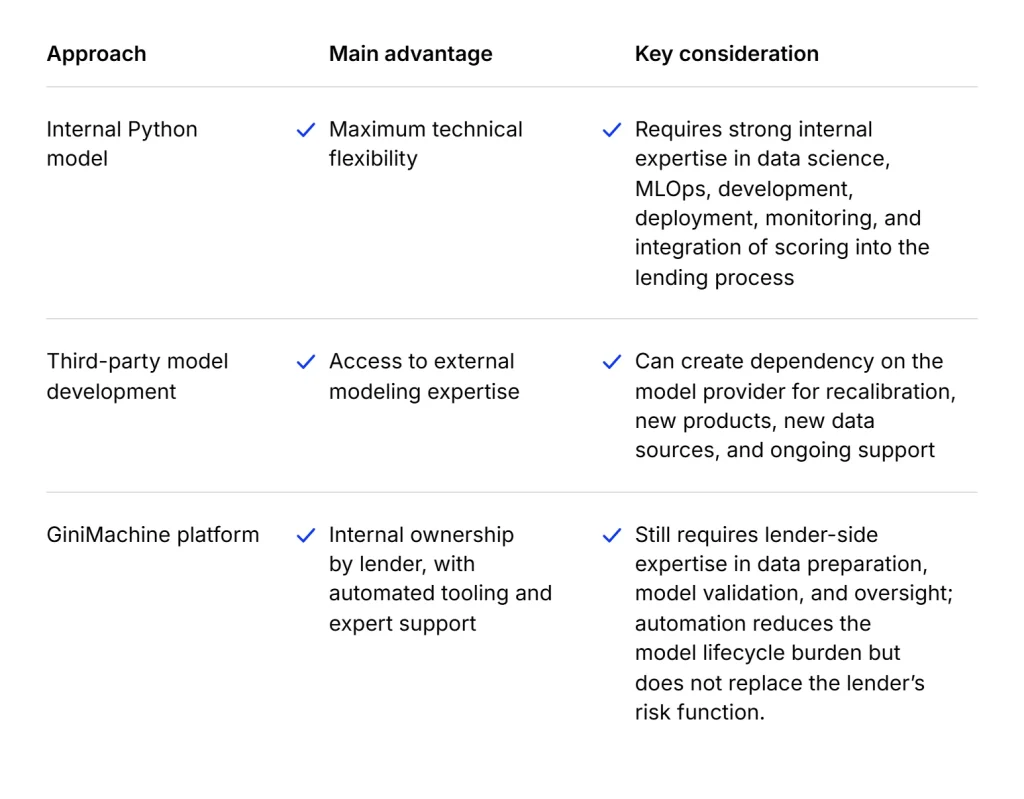
GiniMachine’s value is in automating and standardizing the credit scoring lifecycle: built-in data-quality heuristics, model training, model evaluation and selection, deployment through UI/API, monitoring, retraining, and change logging. Building the same MLOps layer from scratch costs a lender time, budget, and operational overhead, and that cost is usually underestimated at procurement.
To assess data quality and project feasibility, GiniMachine provides a step-by-step guide for data preparation. When needed, the GiniMachine team can also conduct a Data Discovery phase, resulting in data preparation recommendations and a tailored consulting estimate for a specific scoring project.
GiniMachine automates model training, evaluation, and comparison, which reduces manual work and time to obtain a working model, as well as the required level of internal data science expertise.
GiniMachine is already integrated with HES LoanBox, our end-to-end lending platform. It can also be used as a standalone tool through UI/API or integrated into an institution’s existing lending infrastructure. Either way, deployment and lending-process setup take less work than a separate Python model or third-party scoring component.
GiniMachine keeps models, changes, logs, and access rights in one place. This simplifies support, knowledge transfer, role management, review, and audit.
Credit, risk, and management teams can access model performance metrics, score distributions, cut-off configuration, and business insights directly in the web interface, without anyone opening a script or a notebook.
The internal team can use the platform to create, compare, retrain, and adjust models over time. GiniMachine support remains available, while the scoring expertise and decision logic stay within the lending institution.
The platform supports an unlimited number of models for different products, customer segments, and future data sources as the lending portfolio grows.
Subscription plans adapt to scoring volume, deployment format (SaaS, on-premise, or hybrid), and license period, so a lender can test and validate the setup before a longer commitment.
Moving from evaluation to a working scoring model follows a defined sequence. These three steps can be completed with support from the GiniMachine team or independently by the lender’s internal team.
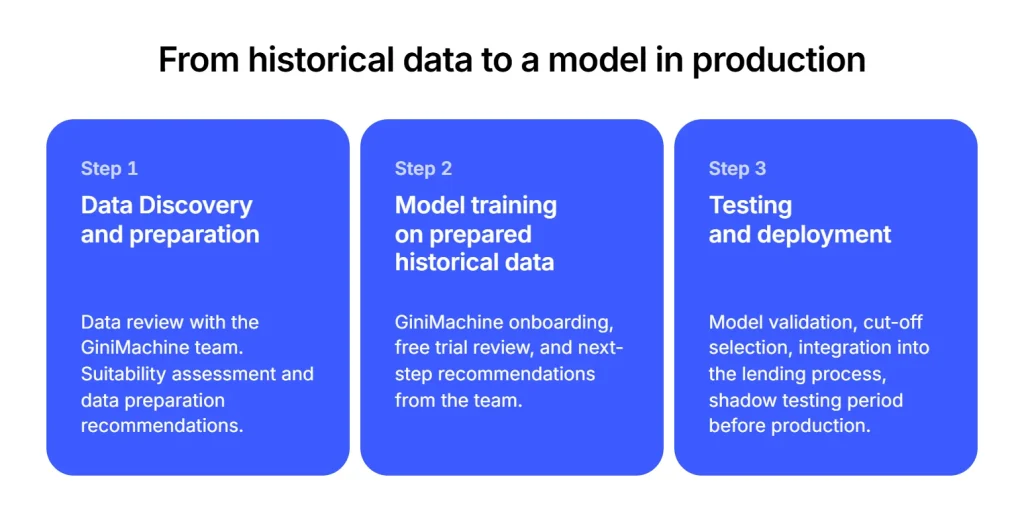
1. Data Discovery and preparation
Start with internal data review or request support from the GiniMachine team. Use our data preparation guide to understand what historical data is needed for model development.
2. Model training in GiniMachine
Train a model using prepared historical data. You can sign up for a free trial. The GiniMachine team will provide onboarding and review trial results with recommendations for the next steps.
3. Testing and deployment
After model validation, cut-off definition, and integration into the lending process, we recommend a shadow testing period before production deployment.
The choice of a credit-scoring approach goes beyond how the initial model is developed. The key question is how the institution will build and retain its scoring capability over time—as portfolios evolve, new products and data sources are added, audit requirements arise, or key specialists leave.
Developing a Python model in-house offers flexibility, but the institution must also build and maintain the surrounding MLOps infrastructure, processes, and expertise. Outsourcing can add valuable external expertise but may create ongoing dependency on the provider for model changes, maintenance, and support.
GiniMachine provides ready-made infrastructure for the scoring model lifecycle, reducing the scope and risk of custom development while the lender’s internal team trains, retrains, and maintains models directly. Credit scoring launches faster and costs less to keep running, and the institution keeps the scoring capability in-house instead of in fragmented scripts or with an external provider.


